Improve Heat Transfer.
Reduce Fouling.
Elevate Output.
THERMOPHASE® is a patented nano-coating technology engineered for condensers and heat exchangers. By modifying the heat-transfer surface, THERMOPHASE helps industrial facilities reduce fouling, improve thermal performance, and maintain more efficient operation.

10,000+ MWs
Proven Track Record Across Power ApplicationsEPRI
Industry Validation & TestingDOE / NETL
Multi Year Operating DataGlobal Applications
Deployed Across Multiple MarketsWhat is THERMOPHASE?
THERMOPHASE is a nano-coating applied to heat-transfer surfaces.
It changes the interaction between the equipment surface and the fluid flowing across it–creating a surface that resists fouling and improves heat transfer.
Development of THERMOPHASE
Developed in partnership with the U.S. Navy, THERMOPHASE successfully reduced biological fouling. Early testing also revealed an unexpected benefit: improved heat transfer in heat exchangers—even those free from fouling. This discovery led to further development of THERMOPHASE in collaboration with the U.S. Navy. Enhanced heat transfer became a defining advantage, extending THERMOPHASE’s value beyond fouling control to improved heat exchanger performance.
How THERMOPHASE Improves Heat Transfer
THERMOPHASE changes the interaction between the heat-transfer surface and the fluid flowing across it. This reduces boundary layer resistance—the thin layer of fluid next to the surface that can act as a barrier to heat transfer.
By modifying the surface, THERMOPHASE increases the contact angle of the fluid and changes how the liquid behaves at the wall. This helps disrupt smooth, laminar flow near the surface and promotes greater fluid mixing.
The result is:
A thinner thermal boundary layer — heat can move through the fluid more easily.
Greater turbulence and mixing — hotter and cooler fluid are exchanged more rapidly near the surface.
A higher heat-transfer coefficient — allowing heat to move between the surface and fluid more efficiently.
Improved performance even on clean equipment — the benefit is not dependent solely on reducing fouling.
Simply put: THERMOPHASE changes the surface so fluid moves and mixes more effectively at the interface. This reduces resistance to heat transfer and allows the equipment to exchange heat more efficiently.

Nano-Coating vs. Conventional Coating
Understanding the THERMOPHASE Difference
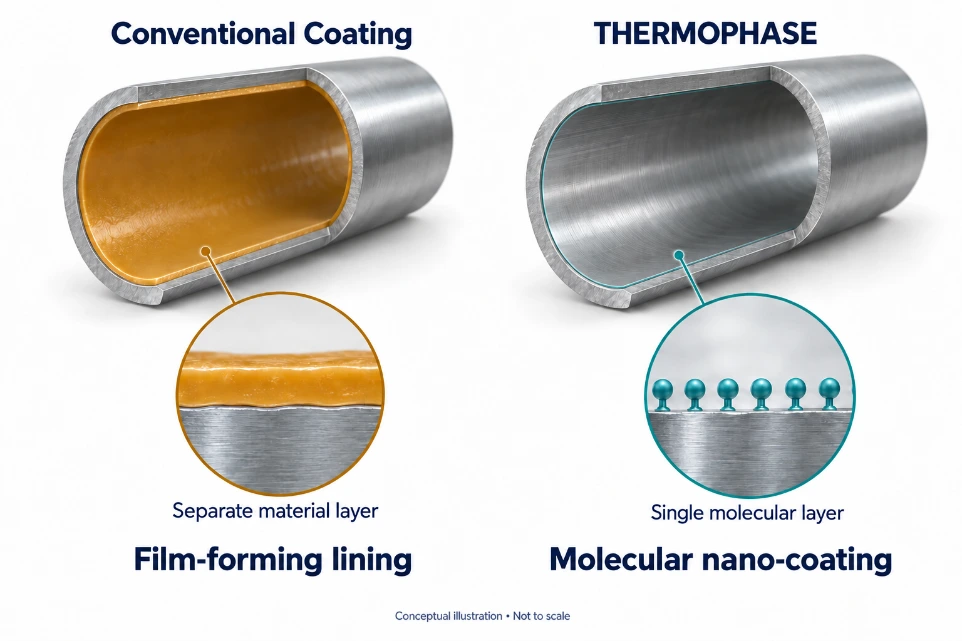
When people hear “coating,” they often picture paint, epoxy, or a lining that builds up inside a tube. THERMOPHASE is a true nano-coating that works at the molecular level.
THERMOPHASE forms a self-assembled monolayer—a single layer of molecules that chemically bonds to the heat transfer surface. It modifies the surface where water meets the metal, without creating the thick film associated with conventional tube linings..
THERMOPHASE works through molecular surface modification. Its bonded nano-coating interferes with the attachment of biological and inorganic fouling and is designed to reduce resistance to heat transfer at the water–surface interface.
THERMOPHASE: molecular-scale surface treatment for better heat transfer.
Power Plant Benefits
Improved Heat Transfer
Alters the boundary layer to promote more efficient heat transfer.Fouling Reduction
Reduces buildup of biological and mineral deposits.Reduced Backpressure
Improved condenser performance can help plants operate at a lower backpressure.Increased MW Output
Improved condenser efficiency can increase generating capability.Reduced Maintenance
Lower fouling levels can reduce cleaning frequency & extend operating periods.Environmental Benefits
Improved efficiency can reduce water use, fuel consumption, & emissions. Non-Biocide, Non-Hazardous, & Non-toxic.
Announcement
August 25, 2026
Pittsburgh Chemical Solutions and Nalco Water, an Ecolab Company, have partnered to become the exclusive specialty chemical supplier of THERMOPHASE™ for the North American Power industry.
THERMOPHASE™ is a patented nanotechnology-based treatment applied periodically to heat transfer surfaces and cooling water systems to improve heat transfer performance and reduce chronic fouling.
Read the latest updates here.

Announcement
May 2, 2026
We are excited to announce a new partnership between Pittsburgh Chemical Solutions (PCS) and 412x972 for the implementation of the THERMOPHASE™ technology into the Israeli market.
Through this partnership, 412x972 will help connect power generation, industrial, manufacturing, and energy-related facilities throughout Israel with THERMOPHASE™, our advanced nano-coating technology.
Read the latest updates here.

Announcement
March 12, 2026
PCS awarded THERMOPHASE™ order for Unit 2 (1,000MW) at the Vistra Beaver Valley Nuclear Plant. After THERMOPHASE™'s impressive performance improvements on Unit 1 (1,000MW), PCS will supply product for Unit 2 (1,000MW) to be applied during Spring 2026. At the request of EPRI, THERMOPHASE™'s success at Beaver Valley will be presented jointly by Vistra Beaver Valley and PCS at the EPRI Balance of Plant Corrosion and Heat Transfer Conference in June 2026.
Read the latest updates here.

Upcoming Presentation
POWERGEN 2026 in San Antonio, TX on January 21, 2026
We continue to see outstanding results with THERMOPHASE™. Join us at POWERGEN 2026, where we will be sharing performance outcomes from multiple power plants. A copy of the presentation can be found in the 'Resources' tab.
Hear directly from Nathaniel Larson of Ethos Energy, Facility Manager at Ocean State Power (508 MW Combined Cycle), as he shares real-world results and insights. We're grateful for Nathaniel for taking the time to present.
Click the following link for more information:

Announcement
November 3, 2025
Pittsburgh Chemical Solutions (PCS) is proud to provide THERMOPHASE™ for an additional 500MW unit in India. This marks the third unit with this utility in 2025 and the second installation at this plant. Our continued performance and proven results have helped us approach 2,000MW of total capacity treated with this valued partner.

Announcement
September 22, 2025
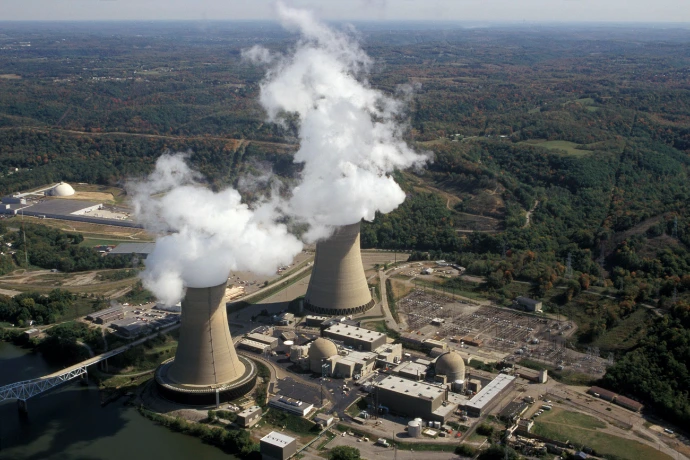
Pittsburgh Chemical Solutions has been awarded a contract for THERMOPHASE™ application at Vistra's Beaver Valley Nuclear Power Plant Unit 1. Beaver Valley Unit 1 can generate up to approximately 1,000MW.
With THERMOPHASE™, we look forward to driving measurable results and supporting Vistra in delivering safe, efficient, and reliable power.
Announcement
September 17, 2025
As THERMOPHASE™ applications continue to grow across various industries, adoption in the power generation market has become a significant tool for utilities. Our installations demonstrate enhanced condenser performance, leading to improved backpressure and turbine output. This allows plants to increase their overall power generation (MW).
For example, a recent unit with THERMOPHASE™ was able to produce additional generation capacity sufficient to power a medium-sized data center. As demand continues to rise, we have shown that THERMOPHASE™ provides a highly cost-effective way to help our utility partners meet demand. With the recent EIA report predicting rising fuel prices, THERMOPHASE™ can also reduce costs while improving plant output and reliability.

Upcoming Presentation
EPRI Heat Exchanger Conference in Minneapolis, MN from July 28-31, 2025
Pittsburgh Chemical Solutions to present THERMOPHASE™ at EPRI (Electric Power Research Institute) Heat Exchanger Conference on July 31, 2025. Click the following link for more information:
https://www.epri.com/events/ecead2a5-28e5-4db6-be2a-fcb802d740d2

Announcement
July 11, 2025
Pittsburgh Chemical Solutions awarded contracts for nearly 1,000MW of THERMOPHASE™ application in this past week, including a major American Southeast utility and another large unit in India.
Announcement
July 2, 2025
Pittsburgh Chemical Solutions THERMOPHASE™ application has completed and is operational on a 500MW unit in India with very successful results. Additional units in India are expected to follow.
Announcement
April 8, 2025
Pittsburgh Chemical Solutions to provide THERMOPHASE™ for evaporators, condensers, and other heat exchangers at Integrated Pulp and Paper Mill.