Longview Case Study: Improving Condenser Performance
At Longview Power in West Virginia, a DOE-funded THERMOPHASE demonstration linked improved condenser performance to an estimated $3.35 million in fuel savings over two years.
Estimated Impact Over Two Years
Water | CO₂ | Fuel Costs |
1.3 Billion Gallons of Water Saved | 136 million pounds less CO₂ emitted | $3.35 million saved in fuel costs |
These are the report’s calculated two-year estimates for Longview, based on observed condenser performance and U.S. Energy Information Administration averages.
Note: This does not include SOx and lime reductions, NOx and Ammonia reductions, Hg and ACI reductions, less ash produced, less chemistry for water used, and water discharged.
Cooling-tower fill benefit: 18% less fouling by dry weight in a separate four-month field test during the 2019 fouling season at the water-treatment facility serving Longview.
The Challenge: Improve Efficiency in an Operating Power Plant
Longview Power operates a coal-fired power plant in Maidsville, West Virginia, equipped with a 770 MW turbine system. Improving the main steam condenser offered a way to reduce the resources required to generate electricity.
The condenser turns exhaust steam from the turbine back into water. When condenser performance declines, turbine backpressure rises, reducing the work the turbine can deliver. Improving condenser performance can help a plant produce electricity with less fuel.
The Solution: Treat Heat-Transfer Surfaces
With funding from the U.S. Department of Energy through NETL, Interphase Materials demonstrated THERMOPHASE on Longview’s main condenser. The advanced surface treatment is designed to improve heat transfer and resist fouling.
The first application began on September 2, 2020, by circulating THERMOPHASE through the condenser during their outage. Later applications took place in July 2021 and August 2022, by dumping THERMOPHASE directly into the cooling tower basin. The condenser tubes were not cleaned before or after application and were not ever cleaned.
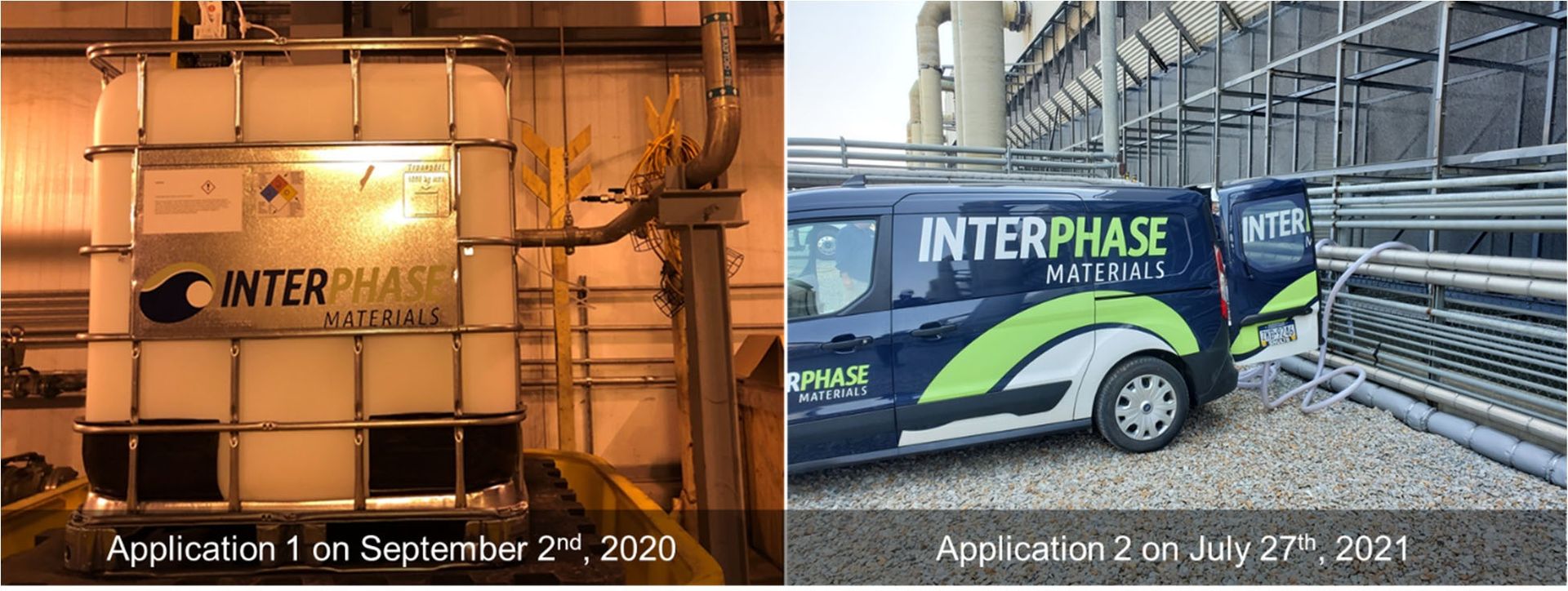
THERMOPHASE applications at Longview Power. Image: Interphase Materials, final technical report, Figure 13, p. 17.
Results: Better Condenser Performance with Meaningful Estimated Savings
Interphase Materials analyzed plant operating records before and after treatment using interrupted time series analysis. After two years, the report identified a net condenser backpressure reduction of 0.26 ± 0.13 inches of mercury, approximately 13%, alongside an approximately 4% improvement in the condenser’s heat-transfer coefficient.
The researchers used the backpressure improvement, published relationships between backpressure and plant efficiency, and EIA averages to estimate the broader impact: 1.287 billion gallons less water withdrawn, 136 million pounds less CO₂ emitted, and $3.35 million in fuel-cost savings over two years.
Cooling-Tower Fill: 18% Less Fouling in Field Testing
The project’s fouling assessment used two small test cooling towers installed at the water-treatment facility serving Longview. The towers circulated untreated water and one tower was treated with THERMOPHASE™.
Over four months during the 2019 fouling season, the treated tower accumulated 18% less fouling by dry weight. This finding supports THERMOPHASE™’s potential to reduce buildup on cooling-tower fill as well as improve heat transfer in condenser applications. It is a separate result from the main-condenser demonstration and the calculated water, CO₂, and fuel-cost savings.
EPRI Validation
Pittsburgh Chemical Solutions reports that testing by the Electric Power Research Institute (EPRI) validated THERMOPHASE™’s heat-transfer performance in new pristine condenser tubes, consistent with the improvements reported across industrial and utility applications, including the DOE/NETL-funded Longview demonstration.
What this Means for Plant Operators
The Longview project brings together evidence of improved condenser performance and reduced cooling-tower fill fouling. Together, these findings support the potential for THERMOPHASE™ to improve operating efficiency, limit fouling, and reduce resource demand. At power-plant scale, a relatively small performance improvement can translate into substantial estimated environmental and financial benefits.
Read the full research report →
Source: Noah Snyder, Interphase Materials, Application of Heat Transfer Enhancement (HTE) System for Improved Efficiency of Power Plant Condensers. Final technical report; DOE award DE-FE0031561. OSTI record, August 8, 2023. DOE funding does not imply government endorsement.